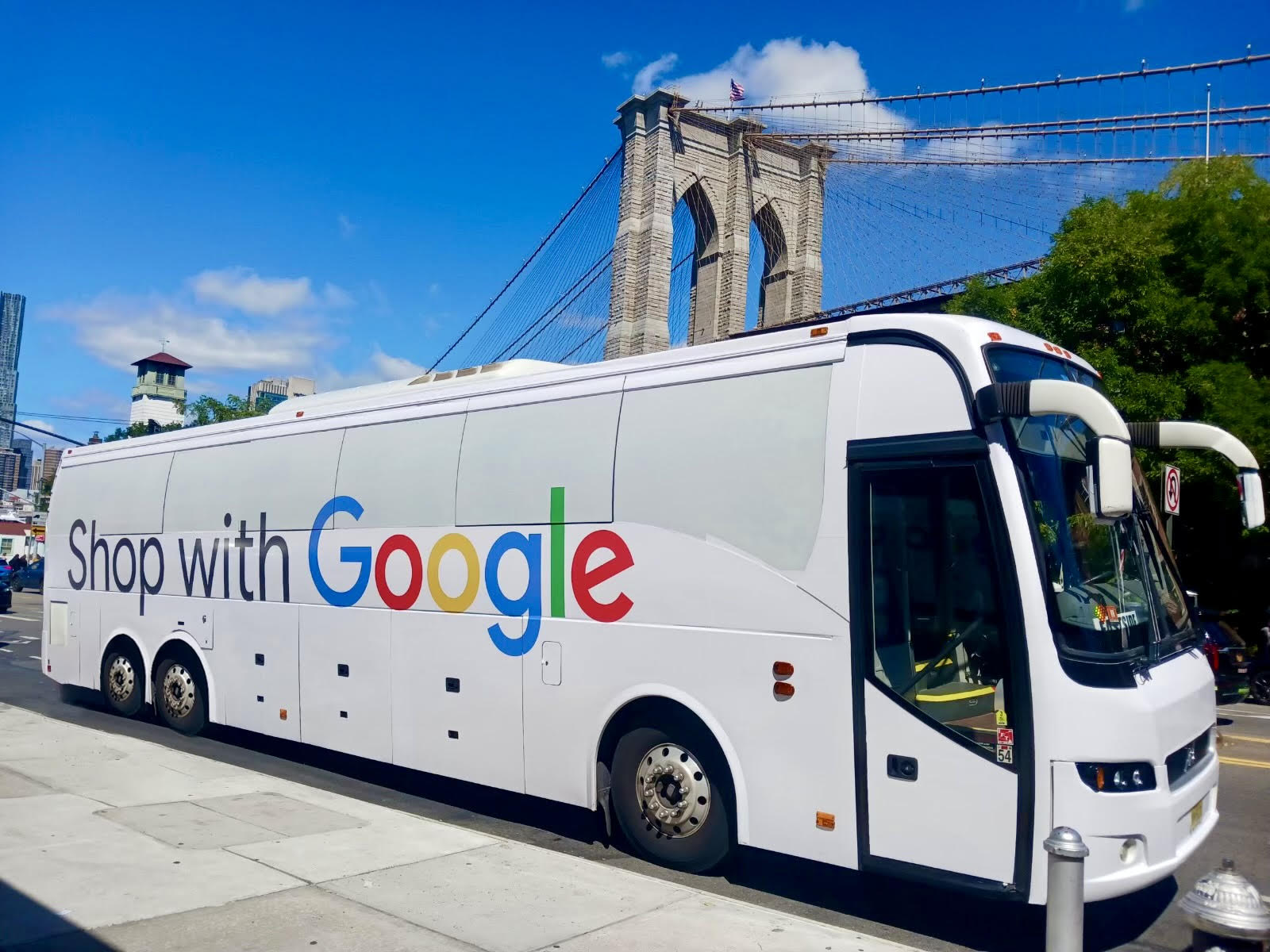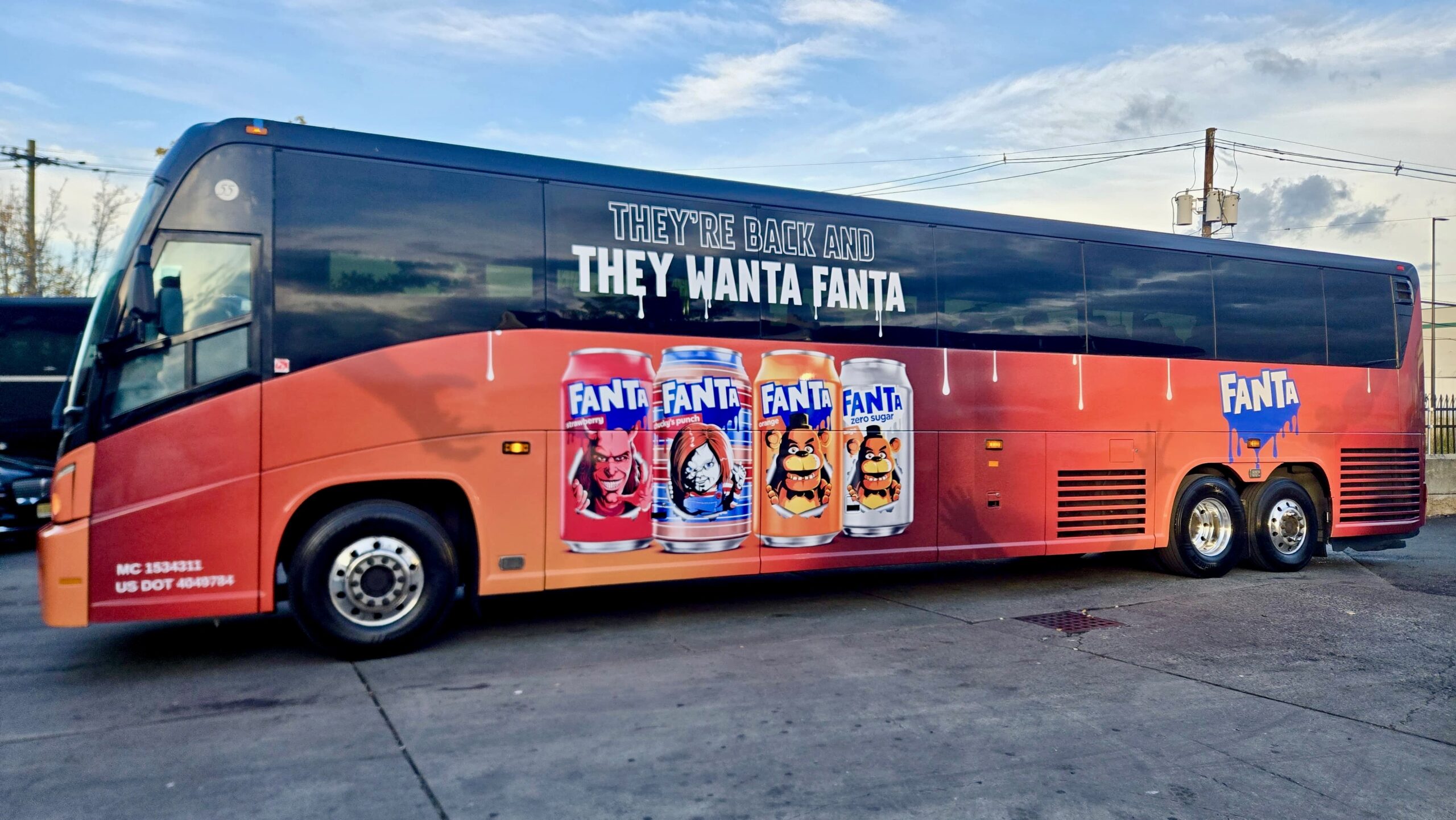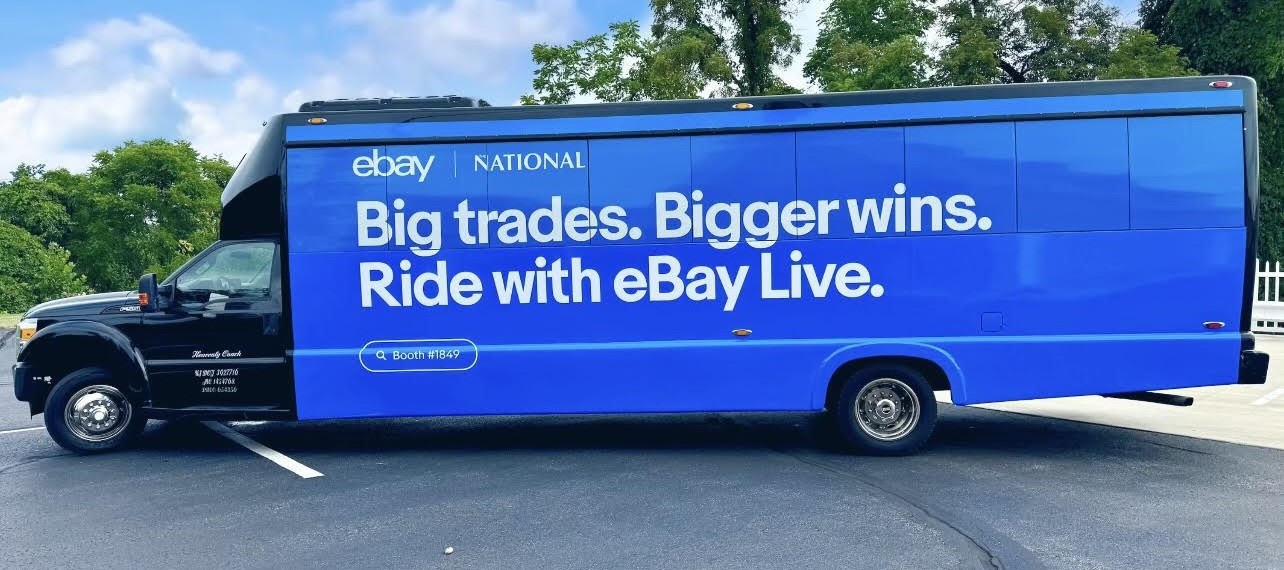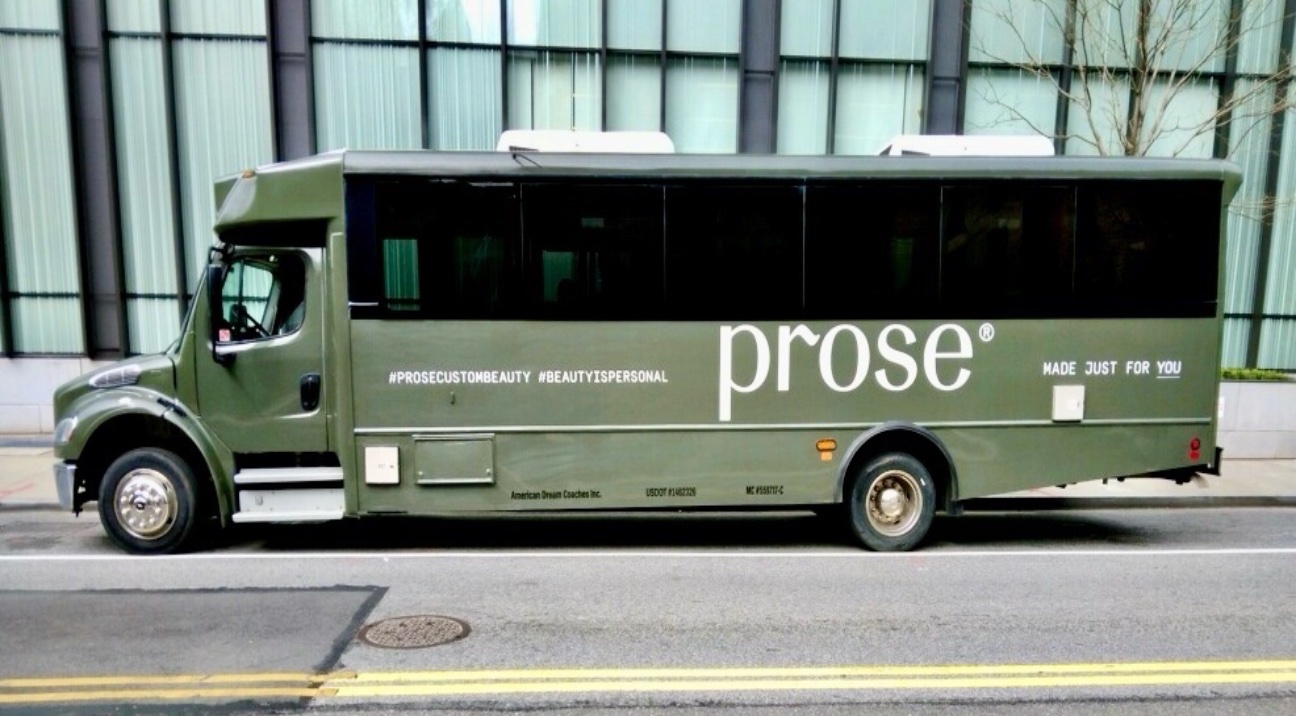

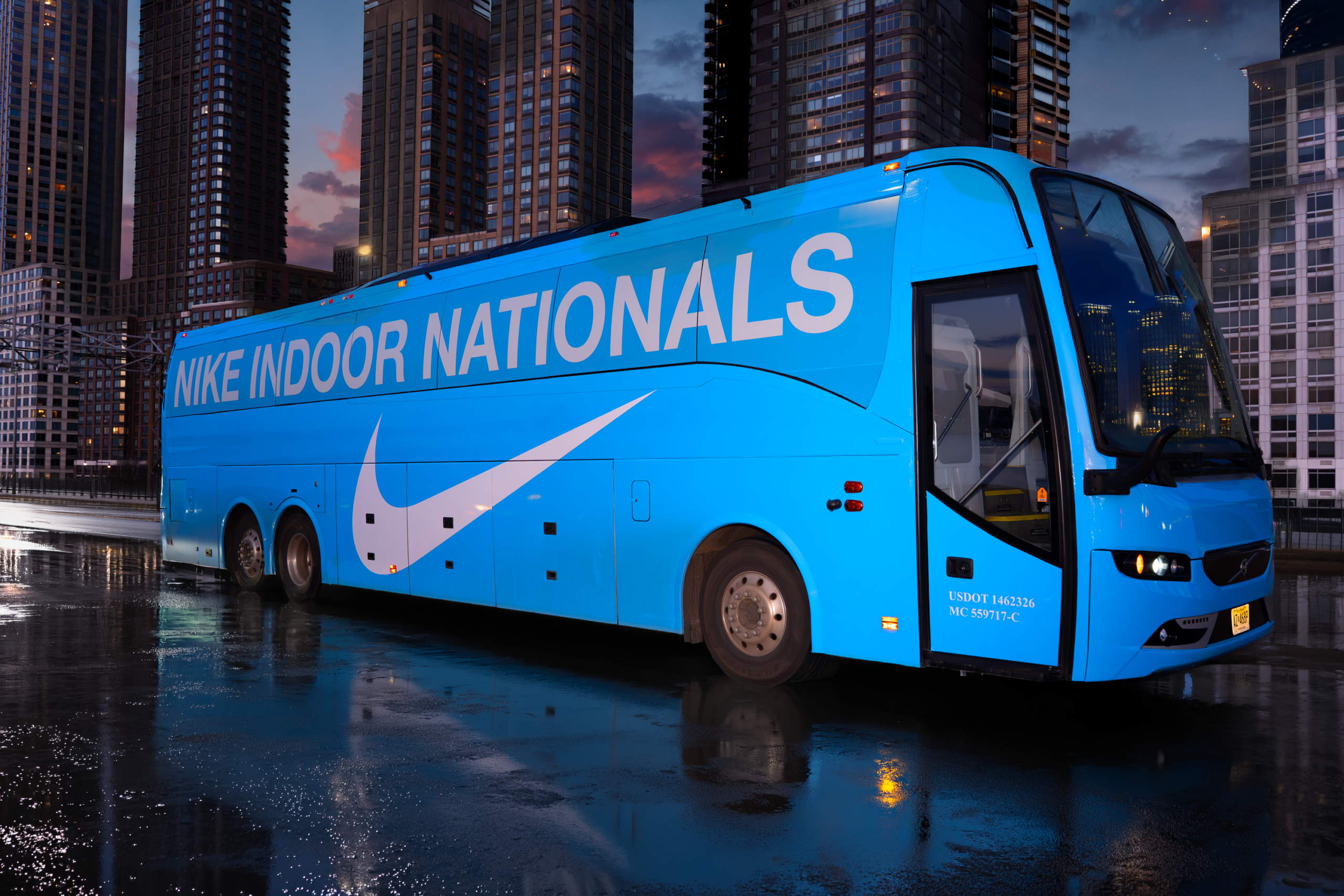
Launching a nationwide bus wrap campaign comes down to eight steps: define your goal, set your budget structure, pick your markets, choose your vehicles and coverage, plan the routing, produce the creative, manage the rollout, and measure what happened. Done right, plan on roughly 8 to 12 weeks from first conversation to first wrapped bus on the road.
And the payoff is real. A single wrapped bus generates an estimated 30,000 to 70,000 impressions per day. Over 10 million Americans ride public transit every weekday, with millions more driving and walking around those routes, and Nielsen research found that out-of-home advertising drives online search at nearly four times the rate its share of ad spend would predict. In fact, 46% of U.S. adults have searched for something after seeing an out-of-home ad. Your buses don’t just get seen. They send people straight to Google.
This guide walks through every step of going national: the strategy, the logistics, the creative rules, and the mistakes that quietly waste big budgets. If you’re still weighing bus wraps against other channels, start with our comparison of bus wraps vs. billboard advertising, then come back. Let’s build your campaign.
What “Nationwide” Actually Means in Bus Advertising
First, a reality check that saves a lot of money. “Nationwide” rarely means every city in America. It means strategic presence across enough major markets that your audience experiences you as a national brand.
The market math
The U.S. is divided into 210 media markets, called DMAs. The top 10 alone (New York, Los Angeles, Chicago, Philadelphia, Dallas, Houston, Atlanta, Washington, D.C., Boston, and San Francisco) cover roughly a third of all U.S. households. Most successful “national” bus campaigns run in 8 to 25 carefully chosen markets, not 200. Presence in the right dozen cities feels nationwide to your audience and to the press.
The two ways to go national
There are two fundamentally different paths, and plenty of campaigns combine them:
- Transit media buys: renting ad space on public transit buses in each market, contracted through transit authorities and their media partners. Broad, route-based, city-by-city exposure.
- Dedicated wrapped fleets: wrapping coaches, sprinters, or mini buses that you control, then routing them wherever your audience is. Tours, event circuits, multi-city activations, and mobile showrooms all live here. This is how brands dominate moments like festivals, championships, and product launches- the way our clients do for events like Coachella and the FIFA World Cup.
Transit buys deliver volume. Dedicated fleets deliver control: your route, your schedule, your parking spot outside the arena. The rest of this guide covers both, and we’ll flag where they differ.

Step 1: Define the Goal Before You Touch a Map
Every decision downstream depends on what you’re actually trying to do. Pick one primary goal:
Brand launch or national awareness
You want maximum reach and frequency. This favors full wraps in dense, high-visibility markets where the visual impact earns attention, photos, and press coverage on top of the impressions themselves.
Supporting retail, franchises, or expansion markets
You’re driving traffic to physical locations. This favors partial wraps and panels concentrated on routes near your locations, plus dedicated vehicles that can park where the customers are.
Event, tour, or product moment
Time-boxed and audience-specific. This favors a dedicated wrapped fleet following the moment: a concert tour, a sports season, a festival circuit, a multi-city launch roadshow.
Whatever the goal, attach a number to it. “Awareness” isn’t measurable. “Lift branded search volume 20% in our launch markets during the flight” is. Nielsen’s finding that OOH generates 26% of offline-media-driven search activations from just 7% of the spend is exactly why branded search lift has become the default KPI for bus campaigns: the behavior is proven, and it shows up in Google Trends and Search Console where you can see it for free.
Step 2: Structure the Budget (Without Guessing at Numbers)
We deliberately won’t quote campaign prices here, because honest pricing depends on your vehicles, coverage levels, markets, and timeline. What we can give you is the structure every national budget follows, so nothing surprises you later.
The four budget buckets
- Space or fleet costs: transit ad rental fees per bus per four-week cycle, or vehicle and routing costs for a dedicated fleet. This is the largest share of most budgets.
- Production: printing and professionally installing the vinyl on every vehicle. This scales with vehicle size and coverage level, which is why a coach and a sprinter price very differently. Our guide to bus wrap cost by vehicle type breaks down exactly how this works across coaches, mini buses, sprinters, vans, and trailers.
- Design and adaptation: one master creative, adapted to every vehicle model and panel format in the campaign. More formats mean more mechanical adaptations.
- Contingency: removal at campaign end, replacement panels, and the occasional vehicle rotated out of service. Experienced planners hold 5 to 10% in reserve.
The rules that stretch any budget
- Longer flights beat bigger fleets. Production is a fixed cost. The longer your wraps stay on the road, the cheaper every impression gets, and longer commitments routinely unlock better space rates too.
- Coverage level is your biggest lever. Full wraps deliver maximum impact, while well-designed partial wraps capture most of the real-world views at a much lower production cost. Our breakdown of full wraps vs. partial wraps vs. decals explains how to choose per market.
- Not every market needs the same treatment. Flagship markets get the statement pieces. Everywhere else gets efficient coverage. More on that mix in Step 4.
For a deeper look at what actually moves wrap pricing up or down, from vehicle size to design complexity, see our guide on how much a bus wrap costs.
Step 3: Choose Your Markets Like a Media Buyer
Resist the temptation to just buy the biggest cities. Build the market list from data.
Start with your customer map
Sales data, web traffic by region, store and franchise locations, and app usage by metro tell you where demand already exists. Bus advertising amplifies existing demand far better than it creates demand from zero. Go where your buyers already are.
Layer in how each market moves
Bus-dense cities like New York, Chicago, Boston, Seattle, and San Francisco put your message into daily street life at slow, readable speeds. Sprawling car-first metros still work well, but formats facing drivers (sides, tails, full wraps at highway scale) outperform formats aimed at transit riders. Match the format to how each city actually travels.
Balance flagship and efficiency markets
A proven structure for national campaigns: anchor in two to four flagship markets for credibility, press value, and social content, then build frequency across 8 to 15 efficiency markets where the same spend buys substantially more presence. The flagships make the campaign feel huge. The efficiency markets make it actually be huge.
Time it around the calendar
Transit inventory tightens around elections, film seasons, and Q4, so book 6 to 10 weeks ahead in major markets. And if your brand can ride a national moment, plan for it deliberately: event-driven campaigns around tentpoles like the World Cup or major festivals concentrate enormous audiences into predictable places and dates, which is the single easiest targeting decision in out-of-home.
Step 4: Pick Vehicles, Formats, and Coverage Per Market
You don’t need the same setup everywhere. Sophisticated national campaigns mix deliberately.
Match the vehicle to the mission
- Coaches and entertainer buses: the largest canvases on the road, built for highway corridors, tours, and statement-level brand presence.
- Minibuses and shuttles: frequency machines on short loops through hotels, campuses, airports, and downtown cores. Perfect for saturating a specific district.
- Sprinters and vans: nimble, street-level, and easy to route through neighborhoods, event perimeters, and dense urban grids where big coaches can’t easily go.
If you’re unsure what each vehicle offers as a wrap canvas, our complete guide to bus wraps covers the fundamentals.
Match the coverage to the market’s role
- Full wraps: your statement pieces. Deploy them in flagship markets, on tour vehicles, and anywhere the wow factor earns organic photos and social posts on top of impressions.
- Partial wraps and king panels: your frequency engine. They cover the sides and rear that drivers and pedestrians actually see, capturing an estimated 70 to 80% of a full wrap’s visual impact.
- Tail panels: your traffic snipers. They face drivers stuck directly behind the bus, ideal for short URLs and single calls to action.
A common national mix puts a minority of vehicles in full wraps for impact and the majority in partials and panels for reach.
Step 5: Plan the Buy and the Routing
If you’re buying transit space
Bus inventory is owned by transit authorities and sold through their exclusive media partners, and inventory across 200+ U.S. markets can now be planned through national media companies and aggregator platforms rather than sending proposals to each transit authority individually. Negotiate on contract length: four-week cycles are the standard unit, but longer commitments typically earn meaningful discounts, and your production costs amortize far better over longer flights anyway.
If you’re running a dedicated fleet
Routing is your superpower, so plan it like media. Map each vehicle’s daily route through the highest-value corridors: commuter arteries in the morning, business and shopping districts midday, event venues and nightlife in the evening. Park deliberately: a wrapped coach positioned outside a stadium, convention center, or festival gate works as a billboard in the exact spot billboards can’t legally exist. This is the play behind experiential and event campaigns, where the bus isn’t just an ad but the brand’s physical presence at the moment.
Either way, demand proof of performance
On a national campaign, you cannot personally verify dozens of vehicles across a dozen cities. Require installation photos, route assignments, or GPS logs, and posting confirmations for every vehicle. Reputable partners provide this without being asked. The paperwork is your eyes.
Step 6: Nail the Creative (One Message, Many Canvases)
National campaigns live or die on creative discipline.
Design for seconds, not minutes
Your viewing window from a passing bus is 3 to 7 seconds. Six words, a dominant logo, one action. Brands that treat a bus like a print ad waste the entire buy. Simplicity isn’t a style choice at this scale. It’s physics.
Build one master system, then adapt everything
Different fleets run different vehicle models with different panel dimensions and body curves. Your designer creates one visual system, then produces precise mechanical adaptations for every vehicle and format in the buy. Skipping this step is how logos end up stretched across wheel wells in three cities.
Make it searchable
Since search lift is your measurable outcome, give people something short and memorable to type: a clean brand name, a tight tagline, or a simple URL. Nielsen’s data shows nearly half of adults search after seeing OOH ads. Your creative’s one job is making that search effortless.
Build in measurement hooks
Campaign-specific URLs, QR codes, and market-specific promo codes turn anonymous impressions into attributable actions, and they tell you which markets and routes pull hardest so you can shift weight mid-campaign.
Step 7: Manage the Rollout Timeline
Here’s what a realistic nationwide launch looks like from kickoff to full deployment:
| Weeks | Phase | What Happens |
|---|---|---|
| 1 to 2 | Strategy and planning | Goals, budget structure, market list, and vehicle mix locked |
| 2 to 4 | Booking and contracts | Transit availability or fleet scheduling confirmed across all markets |
| 3 to 6 | Design and adaptation | Master creative plus mechanicals for every vehicle and format |
| 5 to 8 | Production | Vinyl printed for the full fleet with quality checks before shipping |
| 7 to 10 | Installation | Vehicles wrapped market by market as schedules allow |
| 8 to 12 | Full deployment | All markets live; photo verification and monitoring begin |
Two logistics realities to plan around. First, vehicles get wrapped when schedules allow, so a large campaign deploys in waves over two to three weeks rather than overnight. Build your launch announcement around the flagship market going live, not the last bus. Second, weather and depot access affect installation windows, which is another reason experienced national coordination matters more than any single line item.
Step 8: Measure Like It’s Digital
The old knock on bus advertising was that you couldn’t measure it. That excuse died years ago.
The modern measurement stack
- Branded search lift: compare branded search volume in campaign markets against matched non-campaign markets before, during, and after the flight. The cleanest read available, and free in Google Trends and Search Console.
- Direct response tracking: unique URLs, QR codes, and market-specific promo codes attribute actions directly to the vehicles, and scan rates reveal your strongest markets and routes.
- Geo-lift with holdout markets: deliberately leave two or three comparable markets without buses. If campaign markets outperform the holdouts on traffic, sales, or installs, the difference is your campaign effect. This is how national brands prove OOH return to their finance teams.
- Foot traffic and mobility data: third-party providers can measure store visits from devices exposed along vehicle routes, connecting street-level impressions to real-world visits.
Set the baseline first
Capture two weeks of pre-launch data in every market, including your holdouts. It’s the cheapest step in the entire campaign, and the one most teams forget, and without it you’ll have nothing to compare against when the results come in.
6 Mistakes That Sink Nationwide Campaigns
- Starving production to buy more space. A national campaign with rushed, low-grade vinyl looks bad in twenty cities at once. Hold the quality line on materials and installation.
- Buying markets by ego instead of data. Flagship-city energy is fun, but if your customers are in Dallas, Phoenix, and Charlotte, efficiency-market saturation beats big-city tourism.
- Running too short. One four-week cycle barely gets you noticed. Frequency builds recall, and longer flights amortize production dramatically better. Commit or don’t start.
- One static creative for every market. At minimum, localize the call to action, URL, or offer per market. It incurs little adaptation cost and improves both response and measurement.
- No holdout markets. If every target market gets buses, you can never isolate what the buses did. Leave a control group. Your next budget approval depends on it.
- Too many vendors, no single owner. Separate design, production, installation, and placement vendors across a dozen cities is where national campaigns go to die. Someone has to own the whole board.
FAQ: Nationwide Bus Wrap Campaigns
How much does a nationwide bus wrap campaign cost?
It genuinely depends on your vehicles, coverage levels, number of markets, and flight length, which is why we publish transparent starting estimates instead of vague ranges. See our bus wrap cost by vehicle type guide for real per-vehicle numbers, then talk to us about scaling those across your market list.
How long does it take to launch?
Plan 8 to 12 weeks from kickoff to full deployment. The long poles are booking across multiple markets and the wave-based installation schedule. Event-driven campaigns should work backward from the event date, with a built-in buffer.
How many markets make a campaign “national”?
Most national campaigns run 8 to 25 markets. Because the top 10 media markets cover roughly a third of U.S. households, a smart 12 to 15 market list can credibly feel nationwide to your audience.
Do bus wraps actually drive measurable results?
Yes, and search is the proof. Nielsen found OOH drives online search activations at nearly four times its share of ad spend, with 46% of adults searching for something they saw on out-of-home media. Add QR codes, promo codes, and geo-lift holdouts, and a bus campaign measures nearly as tightly as a digital one.
Should I use transit buses or a dedicated wrapped fleet?
Transit buys maximize volume inside each city. Dedicated fleets maximize control: your routes, your schedule, your parking spot at the event. Awareness campaigns lean transit, while tours, launches, and event activations lean dedicated fleet, and many national campaigns run both.
Can I test before going national?
You should. Run two or three markets for one quarter, measure search lift against holdout markets, then scale what worked. Staged rollouts are one of bus advertising’s biggest advantages over TV or national digital, where you’re forced to buy big on day one.
Conclusion:
A nationwide bus wrap campaign isn’t one big decision. It’s eight disciplined ones: a measurable goal, a structured budget, a data-driven market list, the right vehicle and coverage mix, a smart buy and routing plan, creative built for seconds, a managed rollout, and measurement with holdouts. Get those right, and your brand shows up in a dozen cities at once while your buses send people straight to search. Get them wrong, and you’ve rented very expensive paint.
The brands that win at this treat bus advertising like a performance channel with a brand channel’s presence. Now you know how they do it.
Ready to Take Your Brand National?
Coordinating design, production, installation, and routing across a dozen cities is exactly where campaigns fall apart with too many vendors, and exactly what we handle end to end at Bus Wrap Inc. We’ve run nationwide and event campaigns from coast to coast, with our own fleet of coaches, entertainer buses, mini buses, and sprinters ready to wrap and route wherever your audience is. Browse our case studies to see real campaigns, then reach out for a free campaign plan or call 888-646-6660. We’ll map out the markets, fleet, formats, and timeline your campaign actually needs before you commit a dollar.
Sources: Impression and market data compiled from OAAA research, American Bus Association figures, and U.S. transit industry reports; search activation data from Nielsen’s OOH Online Activation Survey. Impression figures are industry estimates and vary by market, route, and vehicle.